  |
Diana M. Percy
|
|
Contact Details: I am currently
based at the |
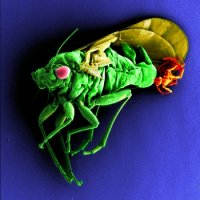
The legume-feeding psyllid, Arytinnis nigralineata (male), with a parasitic mite |

Go to: psyllid Home page, psyllid acoustics, psyllid morphology, Macaronesian island psyllids, Pacific island psyllids, psyllids of economic importance
My research interests
My research has focused on the interactions between plants and insects. I am interested in the evolutionary and ecological dynamics of these interactions, including parasitic phytophagous and mutualistic pollination systems. The other main focus of my research is the radiation and diversification of species on islands. Together, the biogeographic patterns of speciation on islands and the ecological analysis of interacting groups has proved an exciting way to investigate evolution and natural selection.
I have undertaken postdoctoral research on the acoustic signals of Australian psyllids (Psylloidea, Hemiptera), and I have employed a phylogenetic framework (based on molecular data) to investigate the evolutionary role and apparent phylogenetic signal of acoustic characters. I have recorded an astounding diversity of 'songs' from 27 species in 13 genera of Australian psyllids. By selecting a complex of morphologically similar taxa (cryptic species) that occur on closely related host plants, I have assessed the congruence between geographic population structure, acoustic characters and host plant habitat. I have used playback experiments to test female receptivity to conspecific and heterospecific male calls from different hosts. This work, together with an ongoing molecular phylogeny, will be used to investigate the evolutionary patterns of psyllid acoustics (Percy et al. 2006, Percy in prep.). These analyses represent the first systematic study of acoustic diversity in the Psylloidea.
Since 2002, I have been working on the psyllids of the Pacific region, focusing on Pacific Ocean islands. I have visited eastern and western regions of the Pacific to survey the psyllid diversity on different islands, and to determine the host plant associations. Nearing completion is my revision of the psyllids that feed on Metrosideros, and in particular the mechanisms of speciation in the Hawaiian Metrosideros-feeding group. Mitochondrial sequence data sets and morphological descriptions for most of these taxa are now complete.
My PhD
research focused on psyllids found on hosts in the legume tribe Genisteae.
I combined phylogenetic analysis of both the plant and insect groups to
explore the possibility of synchronous, coevolutionary lineages. I also
explored the origins and maintenance of host specificity, and the effects
of habitat alteration on insect-plant dynamics. The central Macaronesian
islands and adjacent continental regions were extensively surveyed to
determine the possible origins and progenitors of the island plant and
psyllid groups. My phylogenetic analysis based on three mitochondrial
gene regions of the Genisteae-feeding psyllids (Arytaininae) found only
one of the three genera to be monophyletic. This genus represents a dramatic
island radiation. Over half the psyllids collected were new species, and
I undertook a taxonomic revision in which I described one new genus, with
descriptions, keys and illustrations for 17 new species and nymphal stages
for a further 15 species (Percy 2003a , Percy
2002).
I have used both molecular and morphological phylogenetic methods to assess
species relationships in the Genisteae-feeding psyllids and their legume
hosts, and to determine the number of colonizations of the Canary Islands
and subsequent inter-island dispersal (Percy 2003b).
I used three mitochondrial genes, cytochrome oxidase I, cytochrome oxidase
II, and the small subunit ribosomal RNA in the molecular analyses of the
insects. For the morphological analysis, both quantitative and qualitative
characters from adult and larval stages were incorporated in a cladistic
analysis. The inclusion of the continental psyllid species enabled me
to determine not only the number of island colonizations, but the possible
historical host associations and subsequent host switching and host shifts
that has produced the apparent pattern of host preference, and host sharing
by multiple psyllid species observed today. To investigate relationships
among the host plants, I constructed a molecular phylogeny for the legume
host group using the nuclear internal transcribed spacer, to investigate
evolutionary patterns in three genera of Macaronesian Genisteae (Percy
& Cronk 2002). With the construction of both legume and psyllid
phylogenies, I was able to use new techniques for dating molecular phylogenies
to assess the extent of contemporaneous speciation in psyllids and their
legume hosts (Percy et al. 2004).
My MSc course (at the Royal Botanic Garden Edinburgh) covered a wide range of plant science subjects including both morphological and molecular studies, classifications using computer databases and computer generated keys, phenetic and cladistic analyses, biodiversity, ecology, and the management and current roles of herberia and botanic gardens. My dissertation focused on the evolution of dioecious breeding systems in two endemic species (Petrobium arboreum, Compositae and Nesohedyotis arborea, Rubiaceae) on the Atlantic Ocean island of St Helena, with reference to the association between plant breeding systems and conservation (Percy & Cronk 1997)
Percy D.M., Argus G.W., Cronk Q.C., Fazekas A.J., Kesanakurti P.R., Burgess K.S., Hajibabaei M., Husband B.C., Newmaster S.G., Barrett S.C.H., Graham S.W. (2014) Understanding the spectacular failure of DNA barcoding in willows (Salix): Does this result from a trans-specific selective sweep? Molecular Ecology doi: 10.1111/mec.12837. pdf (718 kb)
Lubanga U.K., Guédot C., Percy D.M. & Steinbauer M.J. (2014) Semiochemical and vibrational signals mediating mate finding and courtship in Psylloidea (Hemiptera) Insects 5: 577-595 [for Special Issue "Pheromones and Insect Behaviour"]. pdf (443 kb)
Burckhardt D., Ouvrard D., Queiroz D., Percy D. (2014) Psyllid host-plants (Hemiptera: Psylloidea): Resolving a semantic problem. Florida Entomologist 97: 242-246. pdf (69 kb)
Greenslade A., Barclay M.V.L., Hammond P.M., Booth R.G., Bantock T.M., Percy D., Osborne D., Ware C., Shelton J., Weekes J., Ponsonby D., Cameron-Fleming I., Vane-Wright R.I. (2013) The beetles (Coleoptera) of Bingley Island: a preliminary check-list, with additional notes on history, ecology, bugs (Hemiptera) and flowering plants. Entomologist's Gazette 64: 146-165. pdf (293 kb)
Percy, D.M., Rung, A. & Hoddle,
M.S. (2012) An annotated checklist of the psyllids of California (Hemiptera:
Psylloidea). Zootaxa 3193: 1-27.
Percy, D.M. (2011) Insect-plant interactions on islands: codiversification of
legume-feeding psyllids (Psylloidea) and their Fabaceae hosts. In Terrestrial arthropods of Macaronesia – biodiversity, ecology and evolution (eds. A.R.M. Serrano, P.A.V. Borges, M. Boieiro
& P. Oromí). Fundação para Ciência e a Tecnologia.
Burgess, K.S.,
Fazekas, A.J., Kesanakurti, P.R., Graham, S.W., Husband, B.C., Newmaster, S.G.,
Percy, D.M., Hajibabaei, M., & Barrett, S.C.H. (2011) Discriminating plant species in a local temperate flora
using the rbcL+matK DNA barcode. Methods
in Ecology and Evolution DOI: 10.1111/j.2041 210X.2011.00092.x.
Kesanakurti, P.R., Fazekas, A.J., Burgess, K.S., Percy, D.M., Newmaster, S.G., Graham, S.W., Barrett, S.C.H., Hajibabaei, M., & Husband, B.C. (2011) Spatial patterns of plant diversity below ground as revealed by DNA barcoding. Molecular Ecology 20: 1289-1302. pdf (433 kb)
CBOL Plant Working Group (2009) A DNA barcode for land plants. Proceedings of the NationalAcademy of Sciences of the United States of America 106: 12794-12797. pdf (457 kb)
Fazekas A.J., Kesanakurti P.R., Burgess K.S., Percy D.M., Graham S.W., Barrett S.C.H., Newmaster S.G., Hajibabaei M. & B.C. Husband. (2009) Are plant species harder to discriminate than animal species using DNA barcoding markers? Molecular Ecological Resources 9: 130-139. pdf (1036 kb)
Harbaugh D.T., Wagner W.L., Percy D.M., James H.F. & Fleischer R.C. (2009) Genetic structure of the polymorphic Metrosideros (Myrtaceae) complex in the Hawaiian Islands using nuclear microsatellite data. PLoS ONE 4(3): 1-7 (e4698). pdf (381 kb)
Percy, D.M. (2009) Insect Radiations. In Encyclopedia of Islands (eds. R. Gillespie and D. Clague). University of California Press, pp. 460-466.
Cronk, Q.C. & Percy, D.M. (2009) Endemism. In Encyclopedia of Islands (eds. R. Gillespie & D. Clague). University of California Press, pp. 253-258.
Percy, D.M., Garver, A.M., Wagner, W.L., James, H.F., Cunningham, C.W., Miller, S.E. & Fleischer, R.C. (2008) Progressive island colonization and ancient origin of Hawaiian Metrosideros (Myrtaceae). Proceedings of the Royal Society, B-Biological Sciences 275: 1479-1490. pdf (357 kb)
Percy, D.M., Boyd, E.A. & Hoddle, M.S. (2008) Observations of acoustic signaling in three sharpshooters: Homalodisca vitripennis, Homalodisca liturata, and Graphocephala atropunctata (Hemiptera: Cicadellidae). Annals of the Entomological Society of America. 101: 253-259. pdf (313 kb)
Fazekas A.J., Burgess K.S., Kesanakurti P.R., Graham S.W., Newmaster S.G., Husband B.C., Percy D.M., Hajibabaei M. & Barrett S.C. (2008) Multiple multilocus DNA barcodes from the plastid genome discriminate plant species equally well. PLoS ONE 3(7): 1-12 (e2802). pdf (192 kb)
Roderick, G.K. & Percy, D.M. (2008) Insect-plant interactions, diversification, and coevolution: Insights from remote oceanic islands. In Specialization, Speciation, and Radiation. The Evolutionary Biology of Herbivorous Insects (ed. K.J. Tilmon). University of California Press, pp. 151-161.
Percy, D.M., Blackmore, S. & Cronk, Q.C.B. (2007) Island Floras. In A World of Islands: An Island Studies Reader (ed. G. Baldacchino). Agenda Academic and Institute of Island Studies, University of Prince Edward Island, pp. 173-196.
Grandgirard, J., Hoddle, M.S., Petit, J.N., Percy, D.M., Roderick, G.K. & Davies, N. (2007) Pre-introductory risk assessment studies for Gonatocerus ashmeadi (Girault) (Hymenoptera: Mymaridae) for use as a classical biological control agent against Homalodisca vitripennis (Hemiptera: Cicadellidae) in the Society islands of French Polynesia. Biocontrol Science and Technology 17: 809-822.
Percy, D.M., Taylor, G.S. & Kennedy, M. (2006) Psyllid communication: acoustic diversity, mate recognition and phylogenetic signal. Inververtebrate Systematics 20: 431-445. pdf (417 kb)
Grandgirard, J., Hoddle, M.S., Roderick, G.K., Petit, J.N., Percy, D.M, Putoa, R., Garnier, C. & Davies, N. (2006) Invasion of French Polynesia by the glassy-winged sharpshooter, Homalodisca coagulata (Hemiptera: Cicadellidae): a new threat to the South Pacific. Pacific Science 60: 429-438.
Percy, D.M. & Day, M.F. (2005) Observations of unusual acoustic behaviour in two Australian leafhoppers (Hemiptera; Cicadellidae). Journal of Natural History 39: 3407-3417. pdf (328 kb)
Percy, D.M., Page, R.D.M. & Cronk, Q.C.B. (2004) Plant-insect interactions: double-dating associated insect and plant lineages reveals asynchronous radiations. [Invited paper as part of the ‘Untangling Coevolution’ symposium held at the 2001 Evolution meeting, Illinois]. Systematic Biology 53, 120-127. pdf (233 kb)
Percy, D.M. (2003a) Legume-feeding psyllids (Hemiptera, Psylloidea) of the Canary Islands and Madeira. Journal of Natural History 37, 397-461. pdf (1980 kb)
Percy, D.M. (2003b) Radiation, diversity and host plant interactions among island and continental legume-feeding psyllids. Evolution 57, 2540-2556. pdf (1599 kb)
Percy, D.M. (2003c) Book review, ‘Tangled Trees: Phylogeny, Cospeciation, and Coevolution’, ed. R.D.M. Page. Invertebrate Systematics 17, 359-360. pdf (34 kb)
Percy, D.M. (2002) Distribution patterns and taxonomy of some legume-feeding psyllids (Hemiptera; Psylloidea) and their hosts from the Iberian Peninsula, Morocco and Macaronesia. Journal of Insect Systematics and Evolution 33, 291-310. pdf (1054 kb)
Percy, D.M. & Cronk, Q.C.B. (2002) Different fates of island brooms: contrasting evolution in Adenocarpus, Genista and Teline (Genisteae, Leguminosae) in the Canary Islands and Madeira. American Journal of Botany 89, 854-864. pdf (207 kb)
Percy, D. & Oromí, P. (2001) Hemiptera, Psyllidae. Checklist of Canary Island psyllids in Lista de Especies Silvestres de Canarias. p.196. Gobierno de Canarias. Tenerife.
Percy, D.M. &
Cronk, Q.C.B. (1997) Conservation in relation to mating systems in Nesohedyotis
arborea
(Rubiaceae), a rare endemic tree from St Helena. Biological Conservation 84, 135-145. pdf
(1176 kb)
Percy, D.M. (in prep.) Acoustic signals and phylogeography of cryptic species of Eucalyptus-feeding psyllids (Hemiptera; Psylloidea; Spondyliaspidinae).
Keller, M. & Percy, D.M. (in prep.) The courtship sounds of Cotesia rubecula (Hymenoptera: Braconidae).
Go to: psyllid Home page, psyllid acoustics, psyllid morphology, Macaronesian island psyllids, Pacific island psyllids, psyllids of economic importance
All images, unless otherwise noted, are copyright © Diana M. Percy
Created 2002. Updated Feb/2012 Return to top of page
psyllids of economic importance
psyllid taxonomy, host plants, and bibliography site by David Ouvrard et al
